 Katherine Johnson
In a study published in the Journal of Environmental Management led by Tyler Barzee, assistant professor of Biosystems and Agricultural Engineering (BAE) and faculty fellow at the UK James B. Beam Institute for Kentucky Spirits (JBBI); Czarena Crofcheck, professor of BAE and faculty fellow at JBBI; and graduate researcher Danielle Hockensmith, the team discovered that stillage — a leftover byproduct from bourbon and whiskey production — holds the potential to be a sustainable energy supply.
Stillage, which remains after grains are distilled into bourbon, has traditionally been used as feed for livestock. However, Kentucky’s cattle population has reached its lowest point since 1962, while bourbon production is expected to double in the next five years. This imbalance has prompted distilleries to seek alternative ways to manage increasing stillage.
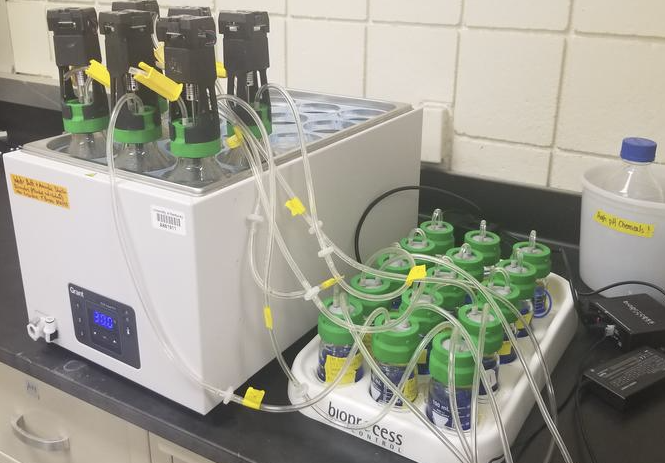
This is where anaerobic digestion, a process that transforms organic material into renewable natural gas by using microorganisms without oxygen, plays a role.
“Stillage has been piling up, and there just aren’t enough cattle to consume it all,” Crofcheck said. “So, distilleries are beginning to explore new ways to use this material, and renewable energy is one of the most promising solutions.”
Research findings and impact
The team’s research analyzed how the composition of bourbon stillage — affected by the different grains used in production — impacts the amount of renewable natural gas generated. Whiskey and bourbon production involves a variety of mash bills (grain combinations such as corn, rye, barley and wheat).
The researchers found that these differences significantly alter the biogas output during anaerobic digestion. This discovery provides distilleries with critical insights into how their byproducts can be efficiently turned into energy, with each type of mash bill producing different methane and carbon dioxide levels.
While this process is common in waste management for agriculture and wastewater treatment industries, it is still relatively new to Kentucky’s bourbon industry. Some large distilleries are leading the way by incorporating anaerobic digesters to convert their stillage into renewable natural gas. The benefits are twofold: distilleries can use the gas for their operations, reducing their reliance on external energy and lowering waste disposal costs.
The researchers noted that the gas can be used in multiple ways, including fueling trucks, heating homes or generating electricity. This creates a valuable opportunity for distilleries to cut energy costs and become more self-sufficient. Some distilleries are exploring the possibility of using their renewable gas to power their operations, such as steam boilers, which are essential for production.
“This study shows that not only can distilleries help alleviate the environmental burden of excess stillage, but they can also create a circular system where waste turns into fuel,” Barzee said. “This is a local solution that could position Kentucky as a leader in both bourbon and renewable energy.”