
WholeSum

Using campus as a classroom: Students explore UK’s energy infrastructure

 At the University of Kentucky, students have access to a dynamic living lab — an 800-acre campus with more than 20 million square feet of building space and all the infrastructure and operations of a small city. At the heart of this opportunity is Facilities Management. In addition to creating an environment where students can learn and excel, Facilities Management is also providing opportunities for students to engage directly with the systems that are essential to the university’s operations.

As part of a technical writing course taught by Holly Osborn, a lecturer in the UK College of Arts and Sciences’ Department of Writing, Rhetoric and Digital Studies, students have the unique opportunity to go behind the scenes. The course, which includes students from diverse majors such as engineering, neuroscience and animal science, is designed to help students hone their technical writing skills through real-world fieldwork.

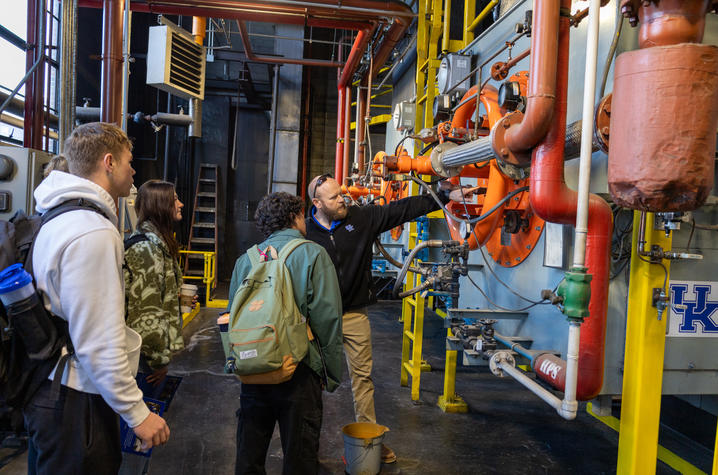
One of the course assignments requires students to research various sustainability initiatives on campus by going out into campus to see firsthand how things work. During this process, students interview campus leaders and explore sites of sustainable practices. Projects explore topics such as waste reduction, food recovery and composting, alternative transportation options and the maintenance of the campus’s tree inventory. This semester, a group of students focused on understanding the energy systems that heat, cool and power the university and this included the opportunity to tour two of the university’s heating and cooling plants

During the tour of these central plants, led by Britney Ragland, associate director of Utilities and Energy Management, and Carter Whitton, utilities systems engineer, students gained insight into how resources like natural gas and water are used to regulate temperature across campus as well as how the university’s stormwater harvesting system operates.

“Seeing this process in action provides a foundation for students to discuss topics like energy saving initiatives in buildings, stormwater harvesting or the university’s goals to reduce emissions on campus,” Osborn said. “The experience of creating the field report is invaluable to them as they prepare to graduate and enter the work force.”

Ragland, Whitton and other members of the Utilities and Energy Management team have provided numerous tours to hundreds of students over the past five years.

“The Utilities Team enjoys sharing our utility plants and electrical infrastructure with student groups because it gives them a tangible real-world example of what they are learning. It prepares them more fully for the careers they are walking into,” Ragland said. “It also opens their eyes to what it takes to keep the campus running, including an appreciation for the people who are on staff 24 hours a day to provide heating, cooling and electricity so they can be successful in their studies.”

Students’ access to hands-on opportunities such as this not only enhances their writing but also prepares them for real-world technical communication roles after graduation.

“The opportunities to see real-world applications of what you’re studying is crucial to your understanding of a topic,” said Mickey Bohan, a mechanical engineering sophomore in Osborn’s class. “Touring the cooling plants allowed me to see significantly more than a picture in a textbook and allowed me to grasp the scale at which the university cooling plants operate.”

Jennifer Allen

We can send you an email whenever a new conversation starts.
Loading

Most discussed