 Cadence Hamilton
Ahead of America Recycles Day on Nov. 15, the University of Kentucky is highlighting the programs, partnerships and people helping advance its goal of becoming a zero-waste campus.
In 2022, UK set the goal of becoming a zero-waste campus as one of the guiding principles for its sustainability efforts and, since then, has recycled 6,779 tons of material, composted 600 tons of food waste and donated 76.5 tons of food and other items. UK defines zero-waste as 90% waste diversion from landfills. To move toward that benchmark, UK Recycling focuses on high-impact materials, events and areas of campus.
“We focus our efforts in three categories: high-impact waste categories like mixed recycling bins and scrap metal collection, high-impact events such as football games and move-in, and high-impact areas of campus, including residence halls and athletics facilities,” said Ryan Lark, zero-waste specialist.
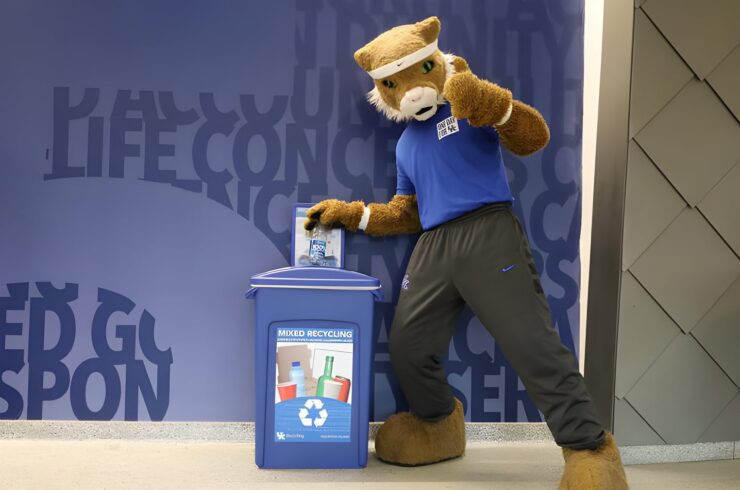
In addition to encouraging usage of the existing recycling options on campus, UK Recycling also seeks to expand the number of items the university can recycle. In 2023, UK expanded the materials accepted in the mixed recycling bins to include paper and plastic cups as well as aluminum foil and plastic food containers. This expansion, supported through a partnership with our new contracted material recovery facility, increased the number of items that can be placed in the blue, mixed recycling bins across campus.
UK has also introduced new tools to reduce contamination and help members of the campus community recycle with confidence. Oscar Sort, an interactive sorting system located in the Gatton Student Center and The 90, can identify and help users sort hundreds of items into the correct bin. The Waste Wizard, launched in 2024, provides another educational resource. Members of the UK community can search for an item online to learn if it can be recycled on campus.
“The Waste Wizard and Oscar Sort are a way to provide recycling education to individuals without anyone having to be there to tell them,” Lark said. “They can use these resources independently at any time of day to learn how to recycle on campus.”
To continue education efforts, Henry Walke, a former UK Recycling intern, created the “Behind the Blue Bins” video to show what happens to recyclable materials collected on campus.
“A lot of people are confused about what happens to their recycling and wonder if their items ever actually get recycled,” said Walke, a senior environmental and sustainability studies and economics double major from Union, Kentucky. “My goal with the video was to demystify the process and create a reliable, quick ‘how-to’ on what happens after recycling leaves campus.”
In 2025, UK expanded its composting operations, opened The Thrifty Cat and added a recycling coordinator to the team, increasing opportunities for the campus community to participate in waste diversion.
The Thrifty Cat, which began as a UK Recycling student project, has grown into a campus thrift initiative and has had more than 770 visitors and has diverted 4,181 pounds of waste from the landfill since opening in the fall of 2025. UK also expanded BBN Tackles Plastic, a grocery bag reuse program piloted in 2025, across campus in 2026.
Erin Geibel, recycling coordinator, works with sustainability interns, manages waste diversion data and coordinates recycling for special events, including through the Big Blue Recycling Crew, a student outreach and sustainability program that provides recycling information during UK Football home games. Since 2016, the program has helped increase waste diversion at Kroger Field, where 30% of game-day waste is now diverted from the landfill.
“The most rewarding parts of joining the UK Recycling team have been mentoring student workers and collaborating with departments and student organizations on programs that build community around waste diversion,” Geibel said.
UK Recycling is far from done. Their efforts continue to expand as the work toward a zero-waste goal continues. UK Recycling’s next initiative, “Turning Up Recycling,” will challenge students living in residence halls to improve their building’s recycling rates.
“Becoming a zero-waste campus is one of the core tenets of our sustainability efforts and it is very exciting to see how far UK’s waste reduction and diversion efforts have come,” said Shane Tedder, director of sustainability.
As the state’s flagship, land-grant institution, the University of Kentucky exists to advance the Commonwealth. We do that by preparing the next generation of leaders — placing students at the heart of everything we do — and transforming the lives of Kentuckians through education, research and creative work, service and healthcare. We pride ourselves on being a catalyst for breakthroughs and a force for healing, a place where ingenuity unfolds. It’s all made possible by our people — visionaries, disruptors and pioneers — who make up 200 academic programs, a $1.02 billion research and development enterprise and a world-class medical center, all on one campus.